
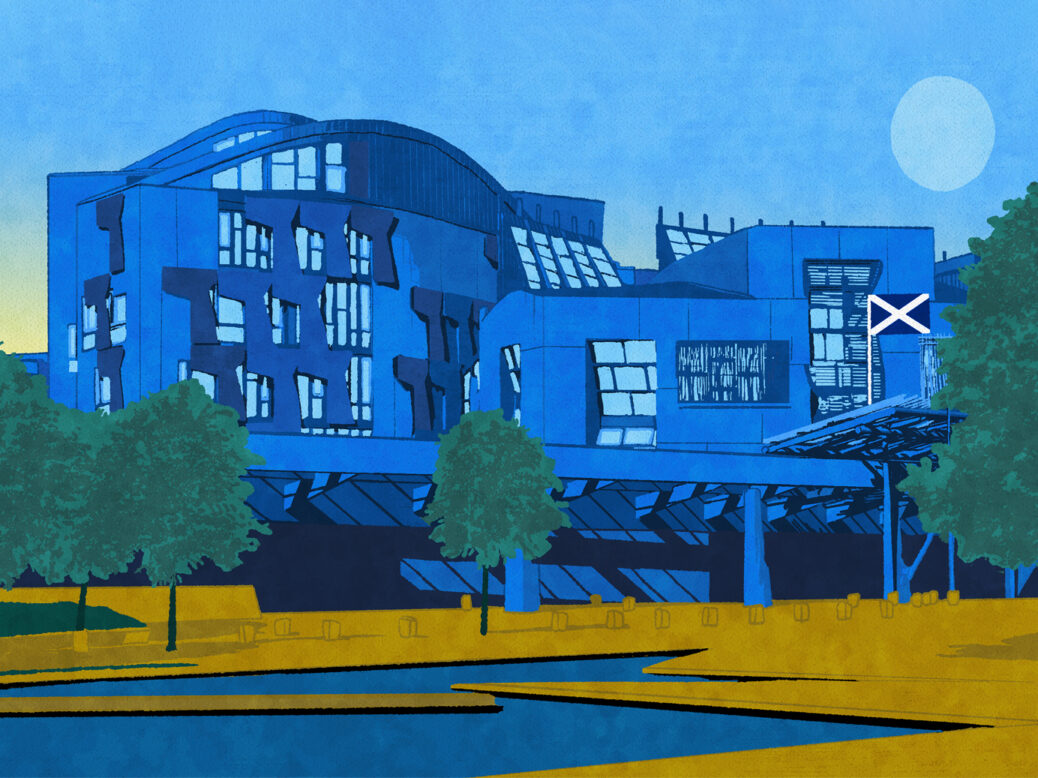
Farewell, then, Holyrood 2021–26. And, frankly, good riddance. What a dismal, low, dishonest parliament this has been, even by devolution’s unimpressive standards.
Farewell to the many supplicant time-servers, who read their questions to ministers directly from cards supplied by the government. Goodbye to the parliamentary committees that showed a complete lack of independence, their members uniformly breaking down along party lines, with a few honourable exceptions. To this tired, error-strewn, scandal-hit government, and its limp, long-serving, unimaginative apparatchiks, who have overseen a half-decade of decline, secrecy and, let’s be honest, relentless whingeing: off you pop.
Three first ministers. A major police investigation. Ministers caught up in a sequence of scandals, yet defended to the end by the first minister. The administration taken to court twice by its information commissioner for failing to release requested material. Undelivered ferries. Unreformed public services. Astronomical levels of drug deaths. A long list of policy U-turns. Heroic levels of spending on welfare and public sector pay, despite repeated warnings from economists about unaffordability. Scotland the brave?
The opposition parties have, sadly, been no better. They have contributed to the loss of public confidence in Holyrood. It is a savage indictment of their weakness that the polls suggest the SNP will be returned on 7 May for a third decade in power, despite its lamentable track record. Labour’s Anas Sarwar and the Conservatives’ Russell Findlay are unlikely to survive what could be historically poor performances by their parties.

I tuned into First Minister’s Questions on Wednesday, the last such session before parliament closed ahead of the election. I do not always do so, because there is little point: a predictable, stale exchange of views, heavy on heat and light on substance. This was no different. In fact, it was worse than usual, as party leaders boasted of their achievements over the course of the parliament while angrily attacking their rivals’ failures. It was complacent and self-serving. It was entirely of a piece with how this parliament has performed.
In truth, there feels little point in looking back. There is so little to detain us or worthy of serious analysis. This will inform the votes of some in a few weeks’ time, but not, it seems, enough to bring about meaningful change. John Swinney will be back in Bute House, with some new faces around the cabinet table, but this conservative, ultra-cautious first minister is too long in the tooth to change his approach. The can will continue to be kicked down the road for as long as possible. The hard choices that so many warn are necessary will continue to be avoided unless a fiscal crisis forces his hand.
It is sad to say that such a crisis may be just what Holyrood needs if it is finally to grow up. In a paper released this week, the Royal Society of Edinburgh called for an end to the tribalism and timidity that have blocked significant policy change in recent years. This would require more than consensus-building rhetoric: it requires political leaders and institutions to make difficult choices, to explain trade-offs honestly, and to sustain focus on outcomes rather than announcements. The challenge, it argued, is cultural as much as structural – to move away from polarisation and towards a politics that takes lived experience seriously, values evidence over misleading narratives, and is judged by whether it delivers meaningful change. This mirrors the views of the Scottish Fiscal Commission, Audit Scotland, the Institute for Fiscal Studies, the Fraser of Allander Institute and my own think tank, Enlighten. Surely they are not all wrong.
Projections show that by the end of the decade the Scottish budget will face a perilous £5bn black hole. This fiscal cliff edge is approaching fast and poses a serious challenge to the prevailing orthodoxy that, under devolution, administrations can spend more generously than Westminster on social policy. The universalist, freebie culture must be re-examined. Rising healthcare costs will have to be met. A solution to social care funding must be found. The need for efficiencies will have to be taken more seriously than it has been until now. The public sector can no longer be feather-bedded in the fashion to which it has become accustomed.
None of this will be easy, but politics is not currently an easy business. The problems Scotland faces are reflected across many countries, and leaders everywhere are under extreme financial and democratic stress. This burden will not lessen in the years ahead: the consequences of the Iran war for the cost of living look likely to be severe and potentially long-standing.
An international crisis does not, however, excuse Scotland’s parliamentarians from making those tough choices and explaining those trade-offs to the electorate. It is all Westminster’s fault is a tired and self-diminishing refrain. It is time ministers and MSPs joined the reality-based community, before reality catches up with them.
I was challenged this week by a senior Scottish businessman about whether there was any point to Holyrood. Had the whole devolution experiment been a mistake? He is not the first to pose the question. Among private-sector leaders in particular, the performative nature of Scottish politics and its seeming inability to improve the condition of the nation is deeply frustrating. They would not get away with it in their own organisations.
For all my grumbling, I remain a supporter of Scotland’s parliament, as I was at its foundation. For all its flaws, it is an essential national institution. I remember well the days of Scottish Questions at Westminster and Michael Forsyth’s Scottish Grand Committee. These were not happy times and did not come close to addressing Scotland’s democratic deficit. But what we have today is not good enough either, and more and more Scots are coming to share that view.
Holyrood 2026–31 must be a different beast from the parliament that has preceded it. It simply has to be, for all our sakes.
[Further reading: Reform UK has plans for Scotland]
Content from our partners


Related
Join the debate
Subscribe here to comment